Rugby captivates with its dynamics and competitive spirit. In Poland, it is not as popular as football or volleyball, but it has its loyal fans. What equipment is necessary to start playing rugby? What rules apply during the game? Discover rugby – the rules of a sport with long traditions!
RUGBY – RULES OF THE GAME AND A BRIEF HISTORY
Rugby is a team sport originating from Great Britain. The oldest written rules were created in 1845 in the town of Rugby, from which the sport takes its name. Today, there are three most popular forms of rugby:
- rugby union – played by fifteen players per team;
- rugby sevens – a seven-a-side version played at the Olympic Games;
- rugby league – played by thirteen players per team.
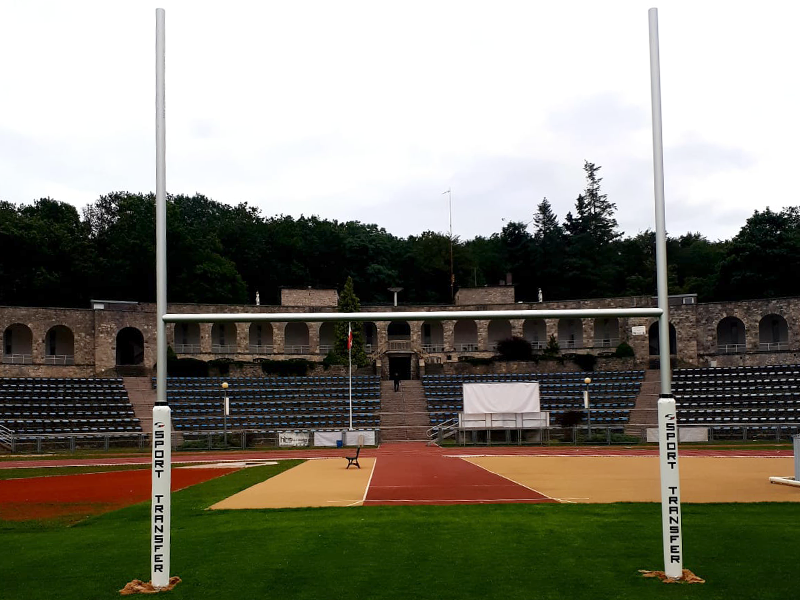
In Poland, the most common version is rugby union (15-a-side). Matches are played on a rectangular field called a pitch, using an oval ball. At both ends of the field, there are H-shaped goalposts.
RUGBY GOALPOSTS – supplied with 800 mm deep ground sockets.
These rugby goalposts feature a reinforced construction. They are made from ribbed aluminum profiles to withstand intense play and harsh weather conditions.
The aim of the game is to score as many points as possible by grounding the ball in the opponent’s in-goal area, kicking it over the crossbar, or scoring penalty kicks.
The basic rules of rugby are relatively easy to understand, although watching a match for the first time may seem chaotic. During play, the ball can only be passed backwards – it can only be kicked forward. Dropping the ball forward is considered a forward pass, resulting in a stoppage and restart of play by the referee.
Characteristic elements of rugby include formations:
- scrum – usually formed by the strongest and most physically powerful players, responsible for contesting possession and restarting play;
- backs (attack) – agile players who aim to break through the opponent’s defense and score points.
You may also be interested in: American football – rules and essential equipment
HOW LONG DOES A RUGBY MATCH LAST?
The duration of a rugby match depends on the format. In rugby union, the most popular version, the game is divided into two halves of 40 minutes each, with a short 5-minute break in between. Rugby league follows a similar structure.
In rugby sevens, due to fewer players and higher intensity, matches are much shorter, consisting of two halves of 7 minutes each.
RUGBY BALL AND OTHER EQUIPMENT
To start playing rugby, appropriate equipment is required. The most important items are the oval ball and protective gear to ensure safety during this intense contact sport.
Rugby Ball
A rugby ball has an oval shape that distinguishes it from balls used in other team sports. According to the rules, its length should be 280–300 mm, its lengthwise circumference 740–770 mm, and its widthwise circumference 580–620 mm.
A match ball weighs 410–460 g. The air pressure inside is also important and should range from 0.67–0.7 kg/cm2. Traditionally made from leather, modern rugby balls are often produced from synthetic materials that are durable and resistant to damage and weather conditions.
1 Polish Rugby Union, Laws of the Game.
Rugby balls are available in different sizes depending on age and skill level. Size 3 is recommended for children, size 4 for youth and women’s competitions, and size 5 is the standard used in professional men’s rugby.
2 https://rugbyklub.pl/pilka-do-rugby/
Rugby – Rules Concerning Headgear
According to the rules, a rugby helmet (scrum cap) is not mandatory. However, wearing one reduces the risk of serious head injuries.
Traditionally worn by front-row players in scrums, scrum caps are now increasingly used by players in all positions. They protect the head and ears (preventing the so-called cauliflower ear) and absorb impacts. To be effective, the cap must fit properly and must not restrict movement or vision.
Rugby is a sport that requires physical strength, discipline, teamwork, and respect for the opponent. Why encourage people to play it? Because although its contact nature may seem intimidating at first, it builds strong bonds between players and motivates them to improve their fitness.
 English