A professional beach volleyball court is designed for official tournaments, but it also serves as a recreational facility for amateurs. It can be built on a beach or anywhere where a الرمل surface can be prepared. Learn more about what a professional beach volleyball court should look like and how matches are played.
BEACH VOLLEYBALL – RULES OF THE GAME
In beach volleyball, two teams of two players each try to hit the ball over the net so that it lands on the opponent’s side.
Each team is allowed a maximum of three touches to return the ball. A block counts as one of them. The scoring system is based on the rally point system, meaning a point is awarded after every rally, regardless of which team served.
A match is played to two winning sets. Sets are played to 21 points, with a requirement of a two-point advantage. If the match is tied 1–1, a deciding set is played to 15 points, also requiring a two-point lead to win.
Women’s and men’s beach volleyball – differences
The main difference between women’s and men’s matches is the height of the net. For women, it is set at 2.24 m, and for men, at 2.43 m.
Women’s beach volleyball focuses more on technique, precision, and long rallies, while men’s matches feature more powerful attacks and serves. However, top female players can attack with power comparable to men.
The course of play is the same for both. Players switch sides every seven points in the first two sets and every five points in the third set.
EQUIPMENT AND COURT – RULES FOR THE PLAYING AREA
Professional beach volleyball courts are prepared according to FIVB standards. The sand layer must be at least 40 cm deep. It should be sifted, free of stones and sharp objects, and neither too coarse nor too fine. Ideal sand does not stick to the skin and does not produce dust during play.
Court dimensions – FIVB standards
A beach volleyball court measures 16x8 m. It is smaller than an indoor court (18x9 m), making the game faster and more dynamic.
A free zone of at least 3 m surrounds the court, and for international competitions, it must be 5–6 m wide. The service zone is located behind the end line, and players can serve from any position within it.
Lines and posts
Court lines are 5 cm wide and must contrast with the sand. Unlike indoor volleyball, there is no center line.
Lines are made of durable tapes, and all fastening elements must be soft and safe.
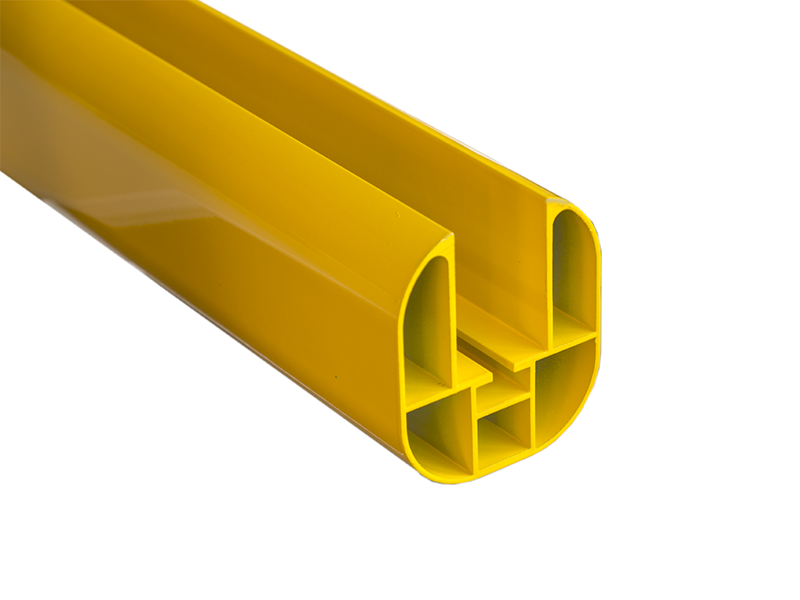
The posts should be 2.50 m high above the surface and made of smooth, rounded materials.
These posts feature an internal tension mechanism that allows smooth net height adjustment. They are installed 0.5–1 m from the sidelines and must be protected with padding.
Beach volleyball net
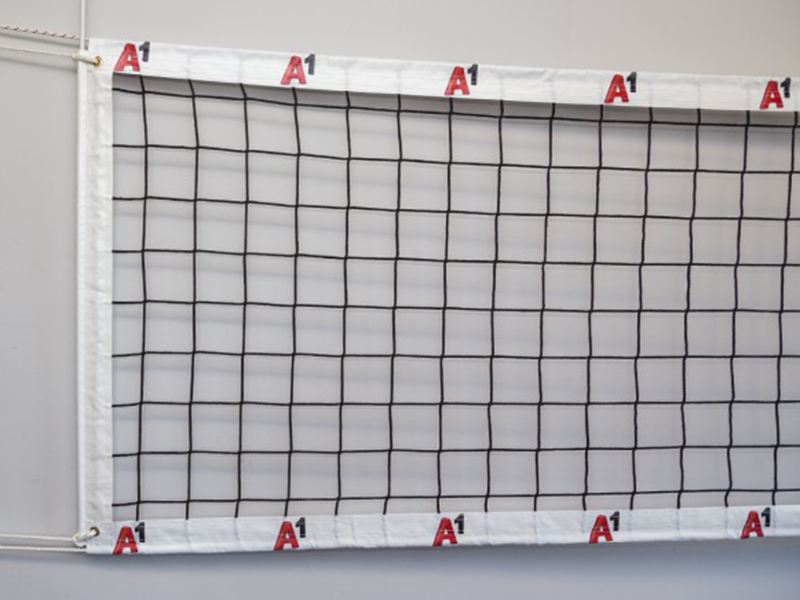
A professional net is 8.5 m long and 1 m wide, with mesh size of 10x10 cm. FIVB competitions may also use 8 m nets with smaller mesh sizes.
The net is made of polypropylene and includes antenna pockets. The top and bottom edges are reinforced with 10 cm bands.
A well-prepared beach volleyball court can become a center for both amateur games and professional tournaments. For the latter, remember to include referee stands, lighting, and scoreboards.
 English