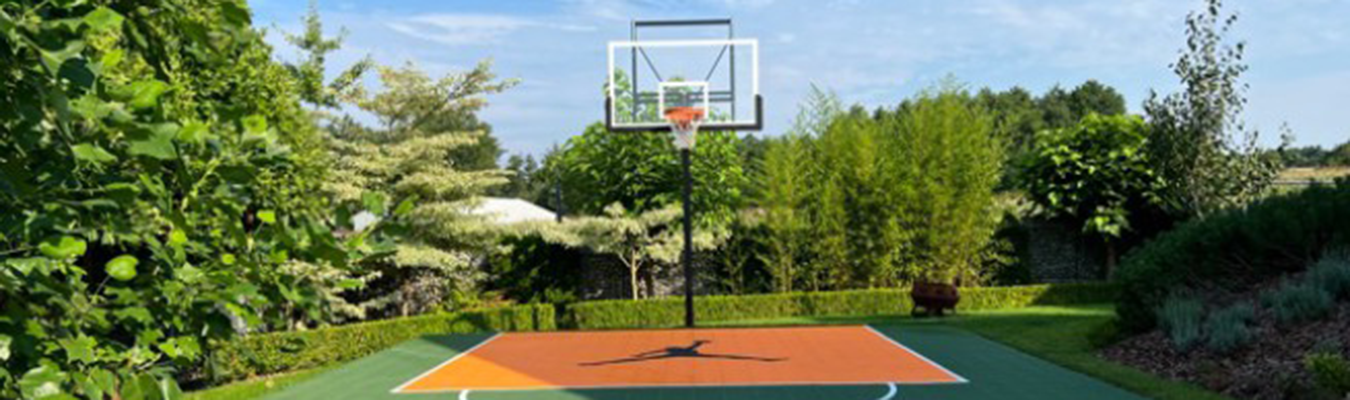
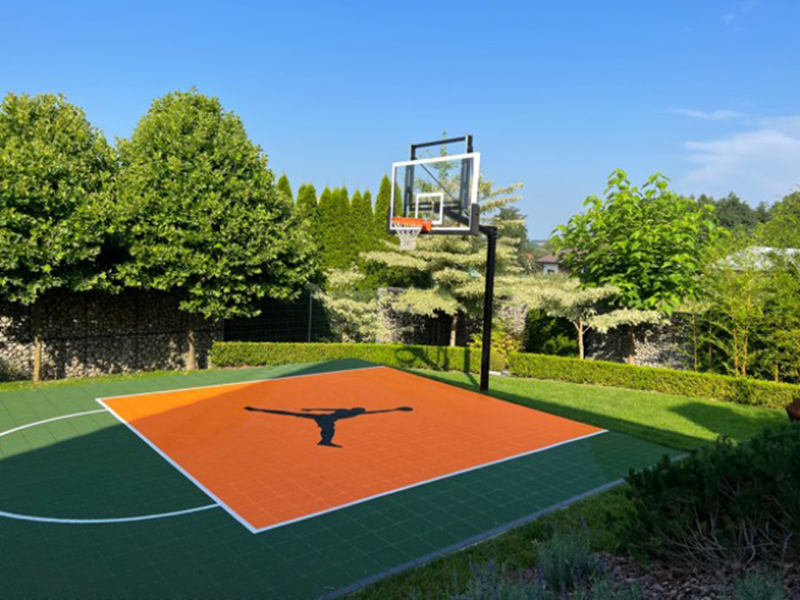
Modern technologies and materials make it relatively easy to create a professional outdoor basketball space. Whether you are planning an investment for a school or a residential area, it can transform how the local community spends their free time. Learn how to create an outdoor basketball court.
WHERE CAN AN OUTDOOR BASKETBALL COURT BE BUILT?
The location where the basketball court is to be built should be away from the street – for the comfort and safety of the players. There should be no hills, depressions, or tree roots on the site. The surface must be leveled, and the ground properly hardened. It is also worth choosing a location with easy access to electricity. Why? Because lighting connected to the grid will allow basketball games to be played after dark as well.
Basketball court dimensions
According to the regulations of the International Basketball Federation (FIBA), the official basketball court dimensions are 28 m in length and 15 m in width. The boundary lines should be measured from their inner edges. Such a full-size basketball court is required for professional competitions and sports facilities. It includes the defensive half (with your own basket) and the offensive half (the opponent’s side).
However, it is not always possible to find a sufficiently large area to build a court that meets FIBA regulations. Therefore, you do not have to strictly follow these guidelines! For recreational or school courts, the dimensions can be flexibly adapted to the available space.
One solution is to build a “half-court”. It includes half of a full-size court with a single basket. This is sufficient for shooting practice, one-on-one games, or popular street basketball matches like 3-on-3. However, even for half-courts, it is important to maintain proper proportions and mark the key lines – the three-point line, free-throw line, and the “key” (the three-second area).
Basketball court surface – for outdoor play
A hard basketball surface can be tough on joints and unsafe during intense play, which is why it is now often replaced with softer materials. Polyurethane surfaces provide much better shock absorption and reduce the risk of injuries.
Polyurethane surfaces consist of several layers. The bottom layer absorbs shocks, while the top layer is hard enough to allow the ball to bounce properly. Modular sports surfaces made of polypropylene consist of square tiles connected with snap systems. Their installation is quick and does not require specialized equipment. Additionally, the perforated structure ensures effective water drainage.
Polyurethane surfaces are available in many color variants. Popular choices include shades of red, green, and blue. Lighter colors reflect sunlight better, reducing surface heating.
Outdoor basketball court – equipment
The basic equipment for an outdoor basketball court that allows enthusiasts to enjoy the game includes:
- backboard structure – fixed (anchored and concreted into the ground) or mobile (mounted on a weighted base);
- rim with net – it is worth investing in a breakaway rim, which absorbs the force of dunks and is much more durable than a standard rigid one;
- basketballs – specifically designed for outdoor use, as they are made of durable materials resistant to abrasion on harder surfaces;
- lighting (optional) – if the court is intended for use after dark.
Read also: Basketball structures – how to install a hoop in a hall and on a court?
FULL-SIZE AND MINI BASKETBALL COURTS – WHY ARE THEY WORTH IT?
A full-size court allows for “real” matches. Teams can train in conditions identical to professional basketball squads. It enables 5-on-5 play while maintaining all official rules and regulations.
A mini court works well where there is not enough space to accommodate a 28x15 m area. Smaller courts are also more economical, as construction and maintenance costs are lower. Material usage and labor are reduced, and the completion time is shorter. Mini courts allow for dynamic games such as streetball – the urban version of basketball.
You may also be interested in: Mini football pitch – where it works best and how to play on it?
Outdoor basketball courts are places where passions are born, friendships are built, and the dreams of future champions may come true. Such an investment pays off in the form of healthier, more physically active youth and a more integrated community.
 English