A match where women and men play together in one team and cooperate on equal terms? Discover korfball! If you are looking for an alternative to traditional team sports or want to organize engaging physical activities for young people, be sure to learn the rules of this fascinating game.
KORFBALL – HISTORY OF AN UNUSUAL SPORT
The history of korfball dates back to 1902. The sport originated in the Netherlands, and its creator was Nico Broekhuysen – a physical education teacher from Amsterdam. During his stay in Sweden, he encountered a game called "ringboll", played by both boys and girls. Inspired by this idea, he decided to create his own version of a sport promoting gender equality and cooperation1.
1 https://www.korfball.pl/wprowadzenie/
The name "korfball" comes from the Dutch word "korf", meaning basket. The sport quickly became popular in the Netherlands, where it remains widely played today. In 1920, korfball was a demonstration sport at the Olympic Games in Antwerp.
The International Korfball Federation (IKF) was established in 1933 and initially included athletes only from Belgium and the Netherlands. After World War II, the sport spread to other countries, including outside Europe. Today, IKF includes over 70 member countries. Since 1978, the World Korfball Championships have been held every four years.
KORFBALL – RULES OF THE GAME
The game is played between two teams, each consisting of 8 players – 4 women and 4 men. The team that scores more points by shooting into the basket wins. A match lasts 2x30 minutes (or 2x10 minutes in the beach version). In the event of a tie, overtime is played using the "golden goal" rule – the first team to score wins.
Korfball – the playing field
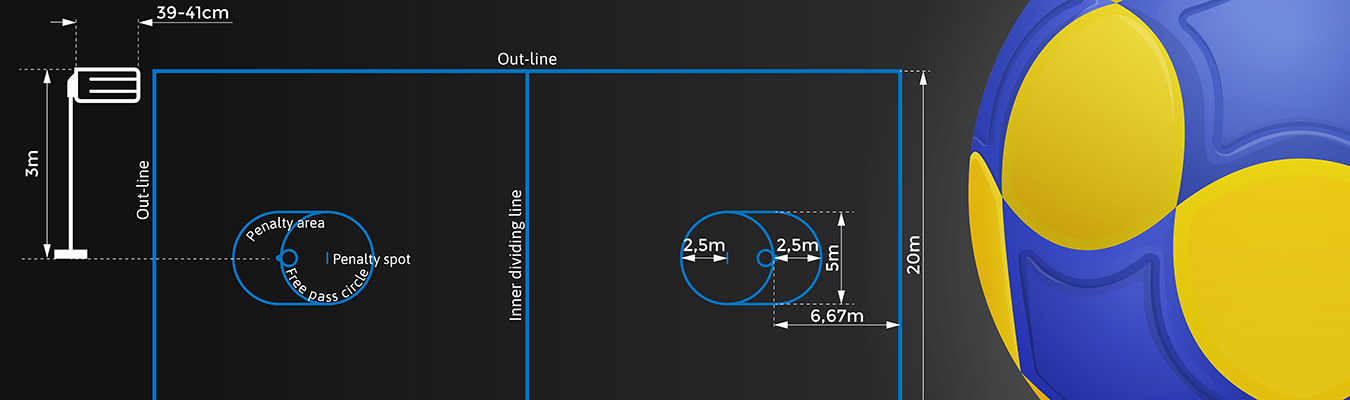
A korfball court measures 40x20 m (indoors) or 60x30 m (outdoors). It is divided into attack and defense zones and split into two equal halves by a center line. Baskets are placed in both halves.
In each zone, there are 2 male and 2 female players from each team. Players may only move within their assigned zone and cannot leave it during play. After every two points scored (by either team), players switch zones – attackers become defenders and vice versa.
Korfball – scoring and movement rules
Points are scored by throwing the ball into the opponent’s basket. The basket is mounted on a 3.5 m high post and has no backboard. Shots can be taken from any position within the attacking zone.
During a korfball match, dribbling is not allowed. Players may only pass the ball. A player with the ball cannot move – they must remain stationary and look for a teammate to pass to. Physical contact is not allowed. Players cannot grab the ball from opponents or push them.
KORFBALL – EQUIPMENT NEEDED
Korfball requires relatively little equipment, making it accessible for schools and clubs with limited budgets. The basic equipment includes a few essential items.
Korfball baskets and posts
Korfball baskets are made of plastic. They have a diameter of 40 cm and a height of 25 cm. The basket has no net – the ball passes through freely. The post holding the basket is 3.5 m high and must be stable and securely fixed to the ground.
Korfball ball
An official korfball is similar to a football but slightly heavier. It has a circumference of 68–70.5 cm and weighs 425–475 g. The ball must have a pattern consisting of at least two colors. In the past, it was very similar to a football, but today its surface is rougher – similar to a basketball2.
2 https://www.korfball.pl/wprowadzenie/sprzet-do-gry-w-korfball/
KORFBALL IN POLAND
Korfball appeared in Poland in the late 1980s. The Polish Korfball Federation (PFK) was established in 1994. Since then, the national team has achieved several successes, including winning the 2022 Beach Korfball World Championship in Morocco.
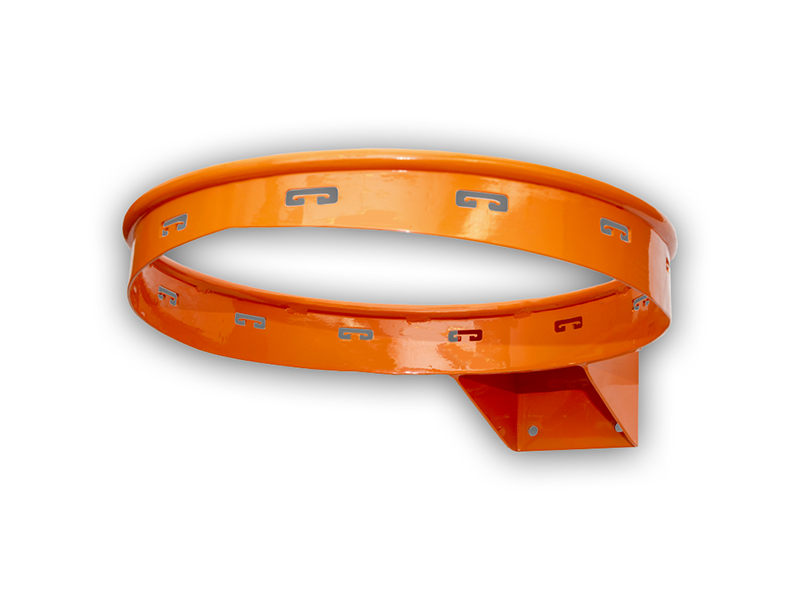
If you are looking for a way to encourage young people to be physically active or introduce a new element to physical education classes, korfball can be a great choice. Don’t have a korfball basket? No problem – at the beginning, a basketball hoop can be used instead.
This powder-coated rim works well both for basketball and for initial korfball training sessions. It is designed for indoor use.
Korfball teaches perseverance, humility, and patience. Scoring requires teamwork, meaning young players must learn to support each other. As a result, it develops both physical fitness and social skills.
 English